
Pursue it, or don’t.
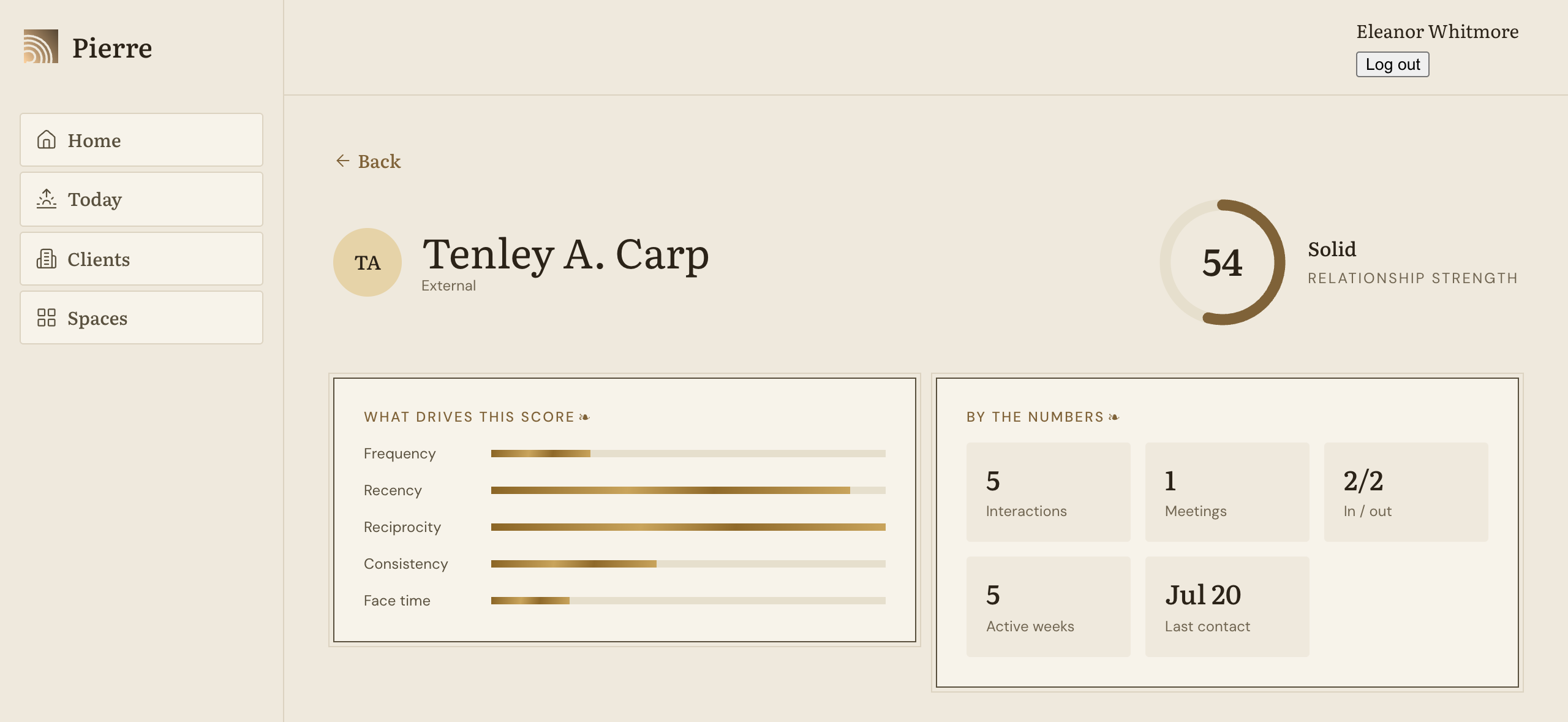
Pierre scores every relationship the firm holds and tells you which pursuits are worth a partner’s hour. The score is computed for whoever is looking, under that person’s own permissions, so two partners can open the same client and see different answers.
Pre-release. We’re taking on two design partners this fall.
Screened matters don’t redact. They don’t exist.
Access isn’t a setting someone remembers to switch on. It’s a property of the data, checked in Postgres on every query, and it denies by default. Pick a viewer and watch what happens to the list.
- Compliance Modernization
- OIG Documentation Response
- Health-Plan Licensure
- Workforce Reduction & Charge
- Privacy Breach-Readiness
app.can_view_matter()Scripted vignette using the demo cast from our seed data, not a live query. The product applies the same rule, app.can_view_matter(), to every real one.
Three things, and it stops there.
The score
A relationship strength for every client contact, rules-based, with no model anywhere in it.
The cited brief
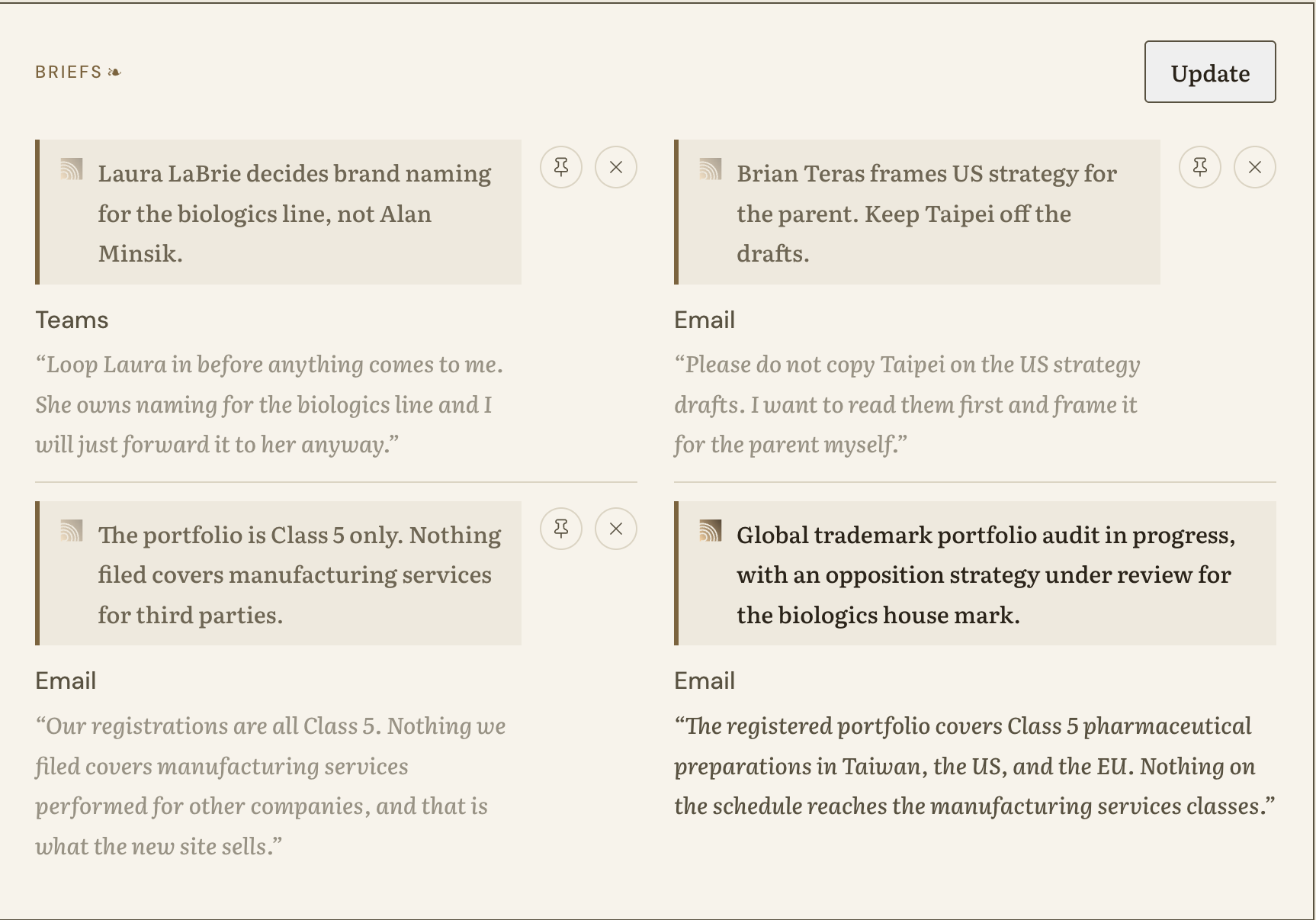
Every line points at the interaction it came from, or the line doesn’t appear.
Nothing to log
No one at the firm types anything into Pierre for it to work.
It comes from inside your practice management system.
Relationship signals are the easy half. The hard half is joining them to what the relationship actually produced — the matters opened, the work billed, the business that came back. Those outcomes already live in the suite your firm pays for, which puts that join within reach of whoever owns the system of record and out of reach of anything bolted on beside it.
Two firms, this fall.
What you get
Your requirements in the product before anyone else’s, a direct line to the people building it, and the wall tested against your own screening rules rather than our sample ones.
What we need
A named sponsor, an hour every other week, and a firm willing to point us at real data once live ingestion is ready.
The timeline
Synthetic data today. First live data December 2026. A go/no-go on general availability in August 2027.
Apply to be a design partner.
Tell us what you run and who you are inside the firm. We read every one of these ourselves and reply within a week.
The questions a general counsel asks first.
How does Pierre map relationships without data entry?
From interaction metadata the firm already produces — who connected with whom, how often, how recently — read out of Microsoft 365 and the systems alongside it. Nobody fills in a form or logs a call. Live ingestion is the piece we’re building next; today the product runs on synthetic data.
How is the ethical wall enforced?
In the database, on every query, rather than in application code where a bug could route around it. It denies by default: a screened lawyer receives zero rows, not a filtered list, and a “screened” instruction always beats a “member” one. This part is built — it’s what the demo above is running.
Can the AI hallucinate something about a client?
The score uses no model at all — it’s rules-based math over interaction records. Where Pierre does use one, every claim must point at a real interaction, and a claim with nothing behind it is suppressed before it reaches you.
Where would our data live?
Each firm gets its own database, and nothing is retained between requests. Pierre draws on outside sources — news, court records, SEC filings, and your CRM — so calls do go out to them. That’s the architecture we’re building to; no firm data flows through it until December 2026.